 Zebra Intelligent - Intelligent Tool Cabinet, Intelligent Material Cabinet, Intelligent RFID Tool Cabinet, Intelligent Racking, Intelligent Warehouse Management



Intelligent shelves in the enterprise administrative supplies warehouse management system in the application of cost reduction and efficiency achievements
summaries
As businesses expand and digital transformation accelerates, traditional warehouse management models for office supplies face challenges such as inefficiency, high costs, and outdated data. Smart shelving—a product of the deep integration of IoT technology and warehouse management—has transformed the entire lifecycle management process for office supplies, from procurement to issuance, through real-time monitoring, data analysis, and automated control. Based on practical case studies from the manufacturing, finance, and internet sectors, this article systematically analyzes the application value of smart shelving in inventory optimization, process streamlining, and decision support; quantifies its achievements in reducing costs and improving efficiency; and outlines future trends in technological evolution.
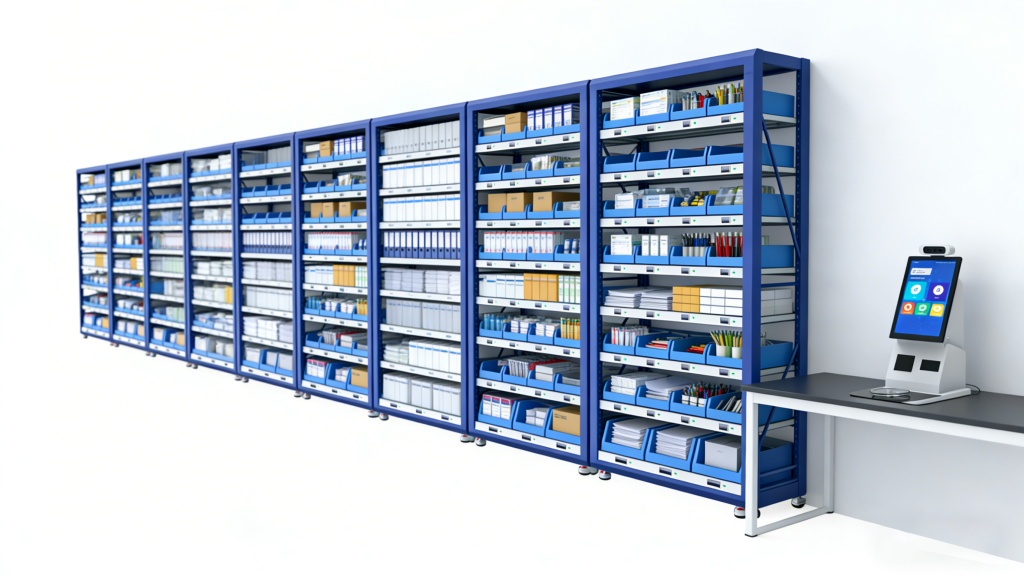
I. Challenges in Traditional Administrative Supplies Warehouse Management
(1) Profile of Typical Issues
- runaway inventory: The error rate in manual inventory counts ranges from 5% to 8%, leading to duplicate purchases (accounting for 12% of annual procurement volume) and dead stock (with an average inventory turnover period of 45 days);
- Process Redundancy: Issuance requires approval at levels 3–5, takes 15–30 minutes per request, and the response delay rate for urgent requests exceeds 60%;
- Data Silos: The ERP, OA, and financial systems operate independently, resulting in low cross-departmental collaboration efficiency and a delay of 7–10 business days in the generation of monthly reports;
- Waste of space: Flat storage results in a storage density of less than 30%, while high-rise racking relies on forklift operations, and the redundancy rate of picking routes reaches 40%.
A survey conducted by a manufacturing group revealed that its six regional warehouses nationwide incur annual production stoppage losses of 23 million yuan due to stockouts, while the cost of capital tied up in excess inventory of administrative supplies exceeds 15 million yuan.
II. Technical Architecture and Core Functions of Smart Shelving
(1) Building a Three-Tier Technical Framework
| Level | Key Technical Components | Functional Implementation |
|---|---|---|
| Perception Layer | RFID tags (UHF/HF), weight sensors, vision recognition cameras, environmental monitoring modules | Collect real-time data on item identification, quantity, location, and storage environment |
| Transport Layer | Industrial Ethernet, LoRaWAN, 5G Slicing, Edge Computing Gateways | Ensuring Low-Latency Data Transmission and Localized Data Processing |
| Platform Layer | Digital Twin Engine, AI Predictive Algorithms, BI Visualization Dashboards, Blockchain Evidence-Storage Interfaces | Integrate functions such as inventory simulation, demand forecasting, and compliance audits |
(2) Four Major Innovative Functional Breakthroughs
- Dynamic Positioning System: Centimeter-level precision positioning is achieved using UWB positioning chips, combined with LED indicators to guide the picking route, reducing the time needed to locate items to one-fifth of that required by traditional methods;
- Automated Metered Replenishment: A built-in pressure sensor monitors inventory levels in real time; when levels fall below a safety threshold, it triggers an automatic replenishment process and integrates with SAP/Oracle systems to generate purchase orders;
- hierarchical control of authority: Integrates facial recognition and fingerprint verification; sets withdrawal limits based on job level (e.g., managers may withdraw up to 500 yuan worth of supplies per transaction); withdrawals exceeding these limits require two-level approval;
- Environmental Adaptive Conditioning: Temperature and humidity sensors automatically control air conditioning and dehumidification equipment to provide optimal storage conditions for specialized consumables (such as ink cartridges and toner cartridges), extending their shelf life by 30% or more.
III. Practical Approaches to Cost Reduction and Efficiency Improvement, and Quantifiable Results
(1) End-to-End Cost Restructuring
1. Optimization of Procurement Costs
- Demand Forecasting Model: An ARIMA forecasting model was built based on historical consumption data (the same period over the past three years plus business growth trends), achieving an accuracy rate of 92%. After implementing this model, a certain automaker reduced the frequency of its printer paper purchases from 3 times per month to 1.2 times;
- Supplier Collaboration: By opening API interfaces to integrate with platforms such as JD Enterprise Purchase and Chenguang Kelipu, a ”zero-inventory” managed inventory model was implemented, resulting in a 18% reduction in annual procurement costs for a provincial branch of a certain bank.
2. Reducing Warehousing Costs
| norm | traditional model | Smart Shelving Model | Magnitude of improvement |
|---|---|---|---|
| Storage Density (units/sq m) | 8-12 | 25-30 | +210% |
| Inventory Cycle (Days) | 3-5 | Live/On-Demand | -90%+ |
| Manual Inspection Hours (hours/month) | 80 | 8 | -90% |
| Percentage of Slow-Moving Inventory (%) | 15-20 | ≤5 | -75% |
Note: Data sourced from the pilot report from Midea Group’s Shunde headquarters
3. Elimination of Hidden Costs
- Correction Costs: The visual identification system automatically verifies picking lists, reducing the error rate from 0.5‰ to 0.001‰;
- Emergency Costs: By setting safety stock alert thresholds, a certain internet company successfully avoided three supply shortages during the "Double 11" period, preventing potential losses of approximately 2 million yuan;
- Training Costs: The onboarding training period for new employees has been reduced from three days to half a day, and the interactive user interface has lowered the learning curve.
(2) Key Scenarios for Efficiency Gains
1. Immediate Supply of High-Volume Consumables
- Warehouse Next to the Production Line: By deploying micro-smart shelves in the automotive final assembly shop and linking them to workstation IDs to enable ”face recognition for retrieval,” the time required to replace A4 printer toner cartridges was reduced from 20 minutes to 5 minutes;
- Sharing Economy Model: A shared supply pool was established, allowing employees to scan a QR code to borrow low-frequency items such as power banks and document folders; the return rate increased to 98%, and the conversion rate of items from personal to shared use reached 65%.
2. Empowerment Through Multidimensional Data Analysis
| Analysis Module | Examples of Output Results | Business Value |
|---|---|---|
| SKU Heat Map | Category A materials (accounting for 20% of the total) accounted for 75% of the total shipments. | Focus on Centralized Management of Core Product Categories |
| ABC Classification Matrix | Brand X's ink cartridge turnover rate is only one-third that of Brand Y. | Eliminate inefficient suppliers and introduce a competitive mechanism |
| Seasonal Fluctuation Curve | Demand for Envelopes and Greeting Cards Surged Threefold in the Fourth Quarter | Stock Up Early to Avoid Price Hikes During Peak Season |
| Ranking of Per-Capita Consumption by Department | The IT Department's USB drive consumption is 2.8 times that of the Administrative Department. | Establish differentiated allocation standards to curb overuse |
3. Remote Monitoring and Mobile Work
- Cloud Monitoring Center: Managers use the app to view real-time footage from warehouses across the country and receive alerts for anomalies (such as unauthorized door openings or high-temperature alarms);
- Mobile Approval Workflow: Executives can submit requests for special approval even while away from the office; for example, the CEO of a real estate group handled a special request for a surveying instrument urgently needed for an African project while on a business trip.
IV. Innovation Practices of Leading Companies
(1) Haier Group—A Closed-Loop Smart Manufacturing Ecosystem
- Scope of Application: With 24 factories worldwide and more than 50,000 administrative staff;
- Featured Solutions: Integrate the administrative supplies warehouse into the COSMOPlat Industrial Internet Platform and share logistics robots with production equipment;
- Key Outcomes:
- The overall inventory turnover days decreased from 42 days to 18 days;
- The response time for urgent orders has been improved to ensure delivery to the workstation within 2 hours;
- Annual labor costs for warehousing were reduced by 27 million yuan.
(2) Industrial and Commercial Bank of China, Zhejiang Branch—A Financial-Grade Risk Control System
- Compliance Highlights:
- A safe compartment can only be opened with two-factor biometric authentication and a dynamic passcode;
- Each transaction is recorded and stored on the blockchain, meeting the audit requirements of the China Banking and Insurance Regulatory Commission;
- Business Innovation:
- Estimate ticket usage based on projected peak customer traffic at branch locations and automatically allocate resources from nearby branches;
- VIP account managers use tablets to handle the distribution of high-end gifts on-site, enhancing the customer experience.
(3) ByteDance—Agile Supply for the Creative Industry
- Industry Adaptation:
- The Designer Zone is equipped with a color-calibrated monitor stand and a dedicated storage area for drawing tablets;
- The live stream prop library supports one-click bundling of lighting and microphone sets;
- Cultural Integration:
- Set up an ”Inspiration Station” that provides free coffee capsules, notepads, and other items designed to spark creativity;
- New hires automatically receive a personalized stationery kit upon joining the company, which helps foster a sense of belonging.
V. Challenges and Response Strategies
(1) Analysis of Existing Bottlenecks
| Areas of Challenge | Specific Manifestations | Solution References |
|---|---|---|
| High initial investment | A single set of mid- to high-end equipment costs approximately 80,000–150,000 yuan, and replacing existing facilities on a large scale would place a significant financial burden on the company. | Using a finance lease model, the cost is amortized over 3–5 years |
| System integration is complex | Integrating with a company's existing ERP/OA systems involves a long development cycle, and protocols from different vendors are incompatible. | Select leading vendors that support RESTful APIs and form a joint working group |
| Changes in User Habits | Long-time employees are resistant to new technology, believing it ”isn’t as flexible as doing it by hand.” | Establish the role of ”Digital Ambassador” and organize skills competitions to reward active participants |
| Information Security Risks | Virus Cross-Contamination via USB Drives; Hacker Attack Causes System Failure | Deploy industrial firewalls and intrusion detection systems; encrypt and store critical data |
| Delay in Maintenance Response | Slow response times for repairs in remote areas and insufficient stockpiles of spare parts | Establish regional service centers and sign SLAs to define response times |
(2) Recommendations for Long-Term Development
- Staged Deployment: Prioritize pilot programs in high-value/high-risk categories (such as precious metals and classified media), and roll out the initiative on a full-scale basis after gaining experience;
- Organizational Change Support Measures: Adjust performance evaluation metrics to include inventory turnover rate and picking accuracy in warehouse clerks' KPIs;
- Knowledge Accumulation and Application: Develop the "Smart Warehousing Operations and Maintenance Manual" to cultivate versatile professionals who are proficient in both business and technology;
- Green and Sustainable: Select energy-efficient components, explore channels for recycling and reusing used consumables, and fulfill ESG responsibilities.
VI. Future direction of evolution
(1) Deepening Technological Convergence
- Quantum Sensing and Localization: Achieves sub-millimeter accuracy, solving the challenge of positioning tiny objects (such as SIM card pins);
- Flexible Electronic Skin: Monitor surface deformation of the shelving units to provide early warnings of structural safety hazards;
- The Evolution of Digital Twins: Build 3D simulation models to simulate survival probabilities under extreme conditions such as fires and earthquakes.
(2) Business Model Innovation
- Subscription-based services: Small and medium-sized enterprises do not need to purchase hardware; they pay for SaaS services based on usage;
- Supply Chain Finance Integration: Provides unsecured loans based on actual transaction data to alleviate cash flow pressures;
- Carbon Footprint Tracking: Assess the environmental impact of each type of consumable and give priority to low-carbon products when making purchases.
(3) Joint Development of Industry Standards
- Led the development of the group standard “Interface Specifications for Intelligent Warehouse Management Systems”;
- Participate in the revision of ISO/TC154 international standards and share China’s practical experience;
- Build industry alliances to promote collaborative innovation across the supply chain.
Conclusion
Smart shelving is not only a smart transformation of physical space but also a revolutionary upgrade to the corporate management paradigm. It breaks through the time and geographical constraints of traditional warehousing, transforming administrative supplies management from a cost center into a value-creation hub. According to a McKinsey study, the return on investment for digital warehousing at leading companies can be 3 to 5 times higher than that of traditional models. Faced with shifts in how Gen Z employees work and the strict constraints of carbon neutrality policies, only by embracing the wave of intelligent technology can we build more resilient organizations for the future. As management guru Peter Drucker once said, ”Innovation is not a gamble; it is purposeful control.” When every single screw is imbued with a digital identity, enterprises’ precision operations will undoubtedly reach a whole new level.
