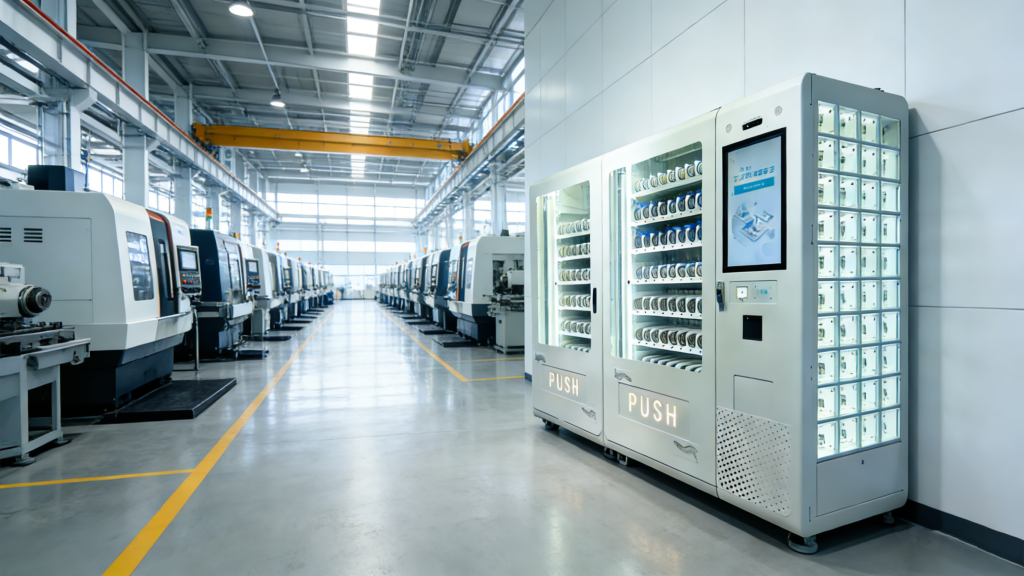
Intelligent tool cabinet: unlocking the core key to efficiency leap in foreign trade shipbuilding factories
In the current wave of global trade, foreign trade shipbuilding factories, as the core force of marine equipment manufacturing, are facing an unprecedented efficiency test. Order delivery cycle is constantly compressed, multinational customers on the quality of the increasingly stringent requirements, the optimization of each production link has become a key factor in determining the competitiveness of the factory. In the huge system of shipbuilding operation, tool management seems to be subtle, but it is like the invisible gear of the production chain, and its operation efficiency directly affects the overall production rhythm.Intelligent tool cabinetThe landing practice, is the power of science and technology to reconfigure the tool management mode, for foreign trade shipbuilding factory efficiency enhancement to open up a new path.
First, break the traditional: foreign trade shipbuilding factory tool management pain points predicament

The complexity and specificity of shipbuilding process determines the high difficulty of tool management. The construction of a 10,000-ton ship involves hundreds of procedures such as steel cutting, welding, grinding, drilling, etc., requiring thousands of types of tools, from large plasma cutting tools to precision milling tools, the specifications spanning a great deal, and the use of the scene dispersed in all corners of the workshop. In the traditional management mode, these pain points are like shackles, firmly binding the factory's production efficiency.
The blindness of inventory control is the primary challenge. The traditional tool inventory relies on manual ledger records, which not only lags behind in updating, but is also prone to omissions and mistakes. Shipbuilding orders have obvious cyclical fluctuations, tool demand surge in peak season, often due to insufficient inventory leads to production line downtime; off-season and due to blind stocking, resulting in a large number of tools backlog, taking up a huge amount of warehousing funds, but also faced with tool corrosion, wear and tear and other risks. According to industry research data show that the traditional mode, foreign trade shipbuilding factory tool inventory turnover rate is generally lower than 50%, a serious waste of funds.
Inefficiencies in receiving returns exacerbate production delays. Workers need to fill out the application to receive the tool, approval and signature, manual search and other links, a set of processes down often take more than half an hour. The return of the same cumbersome, need to check one by one, registered in the warehouse, if the tool is damaged or lost, but also need to carry out complex traceability, not only consumes a lot of manpower, but also often lead to the flow of tools in a timely manner, affecting the subsequent convergence of processes. In the period of tight orders, this inefficient management mode, directly lengthened the production cycle, reducing the efficiency of order delivery.
The lack of loss control has become a cost black hole. In shipbuilding operations, the tool wear rate is extremely high, but traditional management is difficult to realize accurate tracking. The tool is arbitrarily used and operated in violation of the law, resulting in excessive wear and tear or even scrapping of the tool, but it is impossible to accurately locate the cause of the loss and the responsible person. In some factories, the cost of tool loss accounts for more than 15% of the production cost, which has become an invisible black hole that devours profits and makes factories passive in price competition.
The constraints of information silos hinder management upgrading. The data of traditional tool management is scattered in paper ledgers and the memories of different personnel, unable to form a unified, real-time data system. Factory managers are difficult to grasp the tool frequency, loss patterns, inventory dynamics and other core information, can not provide a scientific basis for purchasing decisions, production scheduling, but also can not form a linkage with the factory's overall intelligent production system, which has become the short board of the digital transformation of the factory.
Second, technology empowerment: the core function and value logic of intelligent tool cabinet
Intelligent tool cabinetThe emergence of the traditional tool management dilemma, it is supported by the Internet of Things, big data, artificial intelligence and other cutting-edge technologies, to build a set of full-process, intelligent tool management system for the efficiency of foreign trade shipbuilding factories into the core kinetic energy.
Accurate inventory management for cost reduction and efficiency.Intelligent tool cabinetEquipped with high-precision sensors and intelligent identification system, the system monitors the category, quantity, specification and other information of the knives in the cabinet in real time, and the data is automatically synchronized to the cloud management platform to form a dynamic inventory ledger. When the inventory is lower than the preset threshold, the system will automatically issue a replenishment warning to avoid out-of-stock and out-of-supply; at the same time, the system also combines the order demand and historical consumption data to intelligently predict the demand for cutting tools, optimize the stocking strategy, and reduce the inventory backlog. Through precise control, the factory's tool inventory turnover rate can be increased to more than 85%, significantly reducing the storage capital occupation and making the capital flow more efficient.
Unmanned collection and return to improve the efficiency of flow. With the help of face recognition, fingerprint recognition, work card recognition and other multiple identity authentication technologies, workers can quickly complete the identity verification, self-receive the required knives, the cabinet door automatically pops open, and the process of receiving takes only a few seconds. When returning the tool, put the tool into the designated position, the system automatically recognizes and registers, the whole process without human intervention. This unmanned mode of operation completely breaks the time and space limitations of the traditional collection and return, so that the efficiency of the tool flow to enhance the 90% or more, effectively guaranteeing the continuous operation of the production line, and building a solid foundation for the on-time delivery of orders.
Refined loss control to reduce production costs.Intelligent tool cabinetThe system establishes an exclusive electronic file for each tool, recording in real time the length of time the tool has been used, the frequency of use, the operator, and the wear and tear of the tool. Once the tool has abnormal loss, the system will immediately issue an early warning, and accurately traced back to the operating links and responsible persons, effectively eliminating illegal operation and artificial waste. At the same time, the system can also be based on tool loss data, optimize tool selection and replacement cycle, to avoid unnecessary loss, to help factories reduce tool loss costs of more than 30%, effectively compressed production costs, and enhance profit margins.
Data-driven decision support to empower scientific management.Intelligent tool cabinetThe cloud-based management platform can conduct in-depth mining and analysis of tool usage data, generate visualization reports, and clearly present core information such as tool usage trends, inventory dynamics, and loss distribution. Through these data, factory managers can accurately grasp the rhythm of production, optimize procurement plans, adjust production scheduling, and achieve the optimal allocation of resources. At the same time, these data can also be seamlessly connected with the factory's ERP, MES and other management systems, breaking the information silos, promoting the overall management of the factory to the intelligent, refined upgrade for the factory's scientific decision-making to provide strong support.
Third, the practice of landing: intelligent tool cabinet in the application of foreign trade shipbuilding factory effectiveness
In the practice of many foreign trade shipbuilding plants, theIntelligent tool cabinetThe effectiveness of the application has been fully verified, it not only solves the traditional tool management pain points, but also in the efficiency improvement, cost control, quality assurance and other dimensions, showing a strong value of creativity.
A large foreign trade shipbuilding factory, previously due to tool management chaos, the monthly downtime due to stock-outs of more than 50 hours, tool loss costs accounted for as high as 18%, seriously affecting the order delivery and profit level. IntroductionIntelligent tool cabinetAfter that, the factory has completely revolutionized the tool management. Through intelligent inventory control, the tool out-of-stock rate has been reduced to zero, and the production line downtime has been greatly reduced; unmanned receipt and return mode has improved the tool flow efficiency by 95%, and shortened the production cycle by an average of 15%; refined loss management and control has lowered the cost of tool loss to 12%, which has resulted in cost savings of more than ten million yuan per year. Meanwhile, relying on the data-based decision-making support, the factory optimized the procurement plan, reducing the inventory capital consumption by 40% and significantly improving the efficiency of capital turnover. With efficient production management and stable delivery capacity, the plant has successfully won a number of international high-end orders, and its market competitiveness has been greatly improved.
Another factory focusing on small and medium-sized foreign trade shipbuilding is facing the challenge of small-lot and multi-variety orders, with frequent fluctuations in tool demand, which makes it difficult to adapt to the traditional management model.Intelligent tool cabinetThe introduction of the system has solved this problem for them. The system dynamically adjusts the tool inventory according to the order demand and production plan, accurately matching the tool demand of small orders and avoiding the risk of inventory backlog and out-of-stock. At the same timeIntelligent tool cabinetThe precise traceability function of the factory has effectively standardized the operation of workers, reduced the defective rate of products caused by improper operation, and increased the qualified rate of products by 8%. Efficient tool management and stable product quality have enabled the factory to win a high degree of customer recognition, with a year-on-year increase of orders by 30%, and to successfully stand out from the fierce competition in the market.
In addition to the immediate efficiency and cost-effectivenessIntelligent tool cabinetIt also provides strong support for compliance management and brand building of foreign trade shipbuilding factories. In foreign trade orders, customers have strict requirements for compliance management and quality control of factories.Intelligent tool cabinetThe full-process data traceability function of the factory makes every link of tool management traceable, which meets the customer's requirements for supply chain transparency and improves the factory's compliance management level. Meanwhile, the intelligent management mode highlights the technological strength and management level of the factory, which helps to shape the high-end brand image, enhance customer trust, and lay a solid foundation for developing the international market.
Fourth, the future outlook: intelligent tool cabinet drive shipbuilding factory intelligent upgrade
With the acceleration of intelligent transformation of global manufacturingIntelligent tool cabinetThe value is far more than improving tool management efficiency, it will become a key node to promote the overall intelligent upgrading of foreign trade shipbuilding factories, injecting sustained momentum for the long-term development of the factory.
Future.Intelligent tool cabinetIt will be deeply integrated with the factory's intelligent manufacturing system to form a collaborative and efficient production ecology. By interfacing with the MES system, theIntelligent tool cabinetIt can automatically match the required tools according to the production work order, complete the preparation of tools in advance, and realize the seamless connection between production and tool supply; linkage with the equipment management system, real-time monitoring of the adaptability of tools and production equipment, and timely warning of equipment failures and tool abnormalities, to ensure the stable operation of the production; and synergy with the supply chain system, to realize the intelligent management of the whole chain of tool procurement, inventory, and distribution, and to improve the supply chain response speed. In addition, it can realize the intelligent management of the whole chain of tool procurement, inventory and distribution, and improve the response speed of supply chain, so that the factory can quickly respond to changes in market demand.
The deep application of artificial intelligence technology will empowerIntelligent tool cabinetMore powerful forecasting and decision-making capabilities. By analyzing massive amounts of production data and tool usage data, theIntelligent tool cabinetIt can predict the order demand and tool loss trend in advance, and automatically formulate the optimal procurement plan and inventory strategy; at the same time, based on artificial intelligence algorithms, the system can also optimize the use of tooling solutions, rationally allocate tooling resources, and further enhance the efficiency of tooling use and reduce production costs. In addition.Intelligent tool cabinetIt will also have the ability to learn on its own, and be able to continuously optimize its management mode according to the production characteristics and needs of the factory, so as to achieve personalized and customized tool management services.
Under the general trend of green manufacturing, theIntelligent tool cabinetIt will also help foreign trade shipbuilding factories realize sustainable development. Through accurate loss control and inventory management, tool waste and resource consumption can be reduced; at the same time, the system can categorize and recycle used tools, promote tool recycling, reduce the factory's carbon emissions and environmental impact, help the factory to build a green supply chain, meet the strict requirements of the international market for environmental protection, and enhance the factory's competitiveness for sustainable development.
For foreign trade shipbuilding factoriesIntelligent tool cabinetThe application is not only an effective means to solve the current pain points of tool management, but also a strategic choice to comply with the development trend of intelligence and enhance core competitiveness. In the increasingly fierce competition in global trade, efficiency is life, management is competitiveness.Intelligent tool cabinetWith the power of science and technology, it cracks the traditional management dilemma, releases the production potential, and provides all-round support for the factory's efficiency improvement, cost control, quality assurance and intelligent upgrading.
In the future, as technology continues to innovate and application scenarios continue to expand, theIntelligent tool cabinetIt will play a more important role in foreign trade shipbuilding factories and become the core engine to promote the intelligent transformation of the industry. Those who take the lead in embracingIntelligent tool cabinetThe factory, which actively promotes management innovation, will surely seize the first opportunity in the global market, write a new chapter in the foreign trade shipbuilding industry with efficient, intelligent and green production mode, and ride the wind and waves to a broader future in the vast field of marine equipment manufacturing.
Zebra Intelligent - Intelligent Tool Cabinet, Intelligent Material Cabinet, Intelligent RFID Tool Cabinet, Intelligent Racking, Intelligent Warehouse Management