 Zebra Intelligent - Intelligent Tool Cabinet, Intelligent Material Cabinet, Intelligent RFID Tool Cabinet, Intelligent Racking, Intelligent Warehouse Management



The efficiency advantage of RFID intelligent shelves in the intelligent warehouse management of large logistics enterprises
Introduction: The Need for an Efficiency Revolution in Modern Logistics
In the context of global supply chain restructuring and explosive growth of e-commerce, large logistics companies are facing unprecedented challenges: fragmentation of orders, SKU proliferation, demanding time requirements, the traditional warehousing model has been difficult to support the daily average of millions of parcels processing needs. According to McKinsey research, the head of China's logistics enterprises, warehousing costs accounted for 35%-45% of the total operating costs, of which 60% from inefficient manual work. In this context, RFID (Radio Frequency Identification) intelligent shelves, as a kind of integrated Internet of Things, big data and automation technology innovation program, is becoming a key tool to crack the bottleneck of warehousing efficiency. This article will be from the technical architecture, functional innovation, application scenarios and implementation of the benefits of the four aspects of in-depth analysis, revealing how to reshape the core competitiveness of modern logistics enterprises.
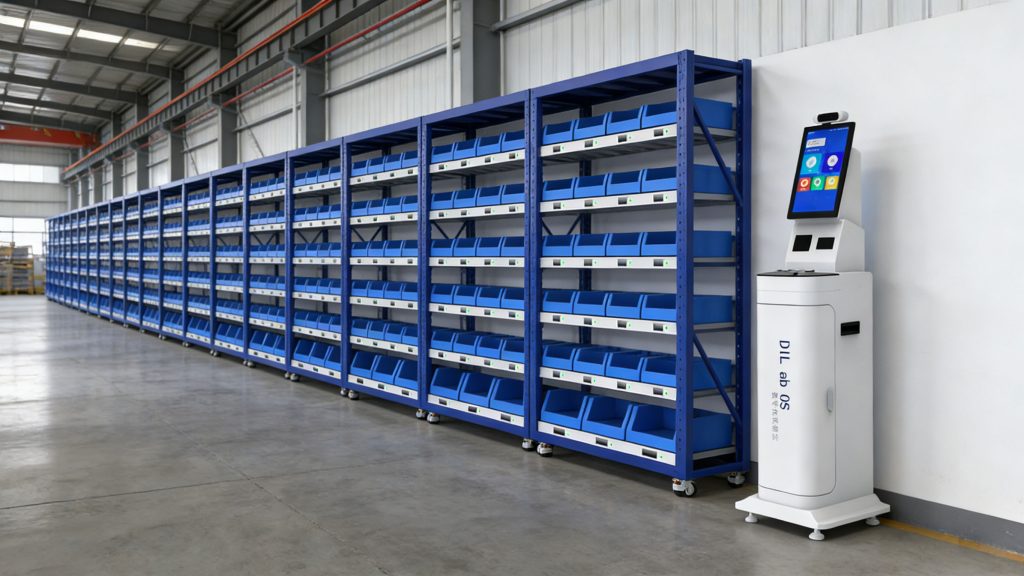
First, RFID technology to enable the underlying logic of warehouse management
1. Technology architecture and synergistic mechanisms
RFID smart shelf is not an isolated device, but to build a “perception - transmission - decision-making - execution” of the complete closed-loop system:
- perceptual layer: It consists of UHF UHF tags (supporting long-distance read/write), multi-antenna array (covering the whole warehouse without dead angle), and environmental sensors (temperature/humidity/smoke/vibration monitoring);
- transport layer: Adopting industrial-grade Wi-Fi 6+5G dual-link backup to ensure real-time backhaul of massive data;
- podium floor: WMS (Warehouse Management System) based on microservices architecture with integrated AI algorithm engine for dynamic optimization;
- implementation layer: Linkage of AGV/AMR robots, automatic sorting lines, robotic arms and other equipment to complete physical operations.
Example of workflow: When RFID-tagged goods enter the warehouse, the door reader instantly captures the product information and uploads it to the system; during the shelving process, the light picking system guides the operator to place the goods in the optimal storage position; when the goods are taken out of the warehouse, the system automatically verifies the accuracy of the order and triggers the picking instruction. The entire process requires no human intervention and the error rate is close to zero.
2. Core advantages over traditional barcode/2D code
| dimension (math.) | Barcode/QR Code | RFID Smart Shelf |
|---|---|---|
| recognition distance | Requires close alignment scanning | Up to 10 meters or more, penetrates cardboard boxes/wooden frames to identify |
| Batch processing capability | Individual pieces scanned in sequence | Hundreds of synchronized reads per second |
| environmental adaptation | Defective when soiled/folded | Resistant to oil/moisture/metal interference for durability |
| data capacity | Tens of bytes of text information | Stores rich media such as pictures/videos/maintenance records |
| life cycle management | static marking | Support for dynamic updates (e.g., expiration date/location changes) |
| covert installation | Must be posted externally | Can be embedded inside packages or equipment housings |
Especially worth emphasizing is that, for cross-border logistics common pallet level full container transportation scenarios, RFID can realize the “non-opening inspection” - through the forklift channel door read-write, in the vehicle passes through the moment to complete the whole pallet of goods inventory, compared with the manual sampling efficiency to enhance More than 20 times.
Second, RFID intelligent shelf function innovation and value creation
1. Full-process visualization and control system
- 3D space-time mapping: Create a real-time synchronized model of physical shelves and digital twins that can preview the status of any shelf in virtual space;
- Heat Map Navigation: Generate color gradients based on historical out-of-stock frequencies, and new hires can quickly locate areas of best-sellers;
- Anomaly warning radar: Set safety stock thresholds with 72-hour advance warning of out-of-stock/lagging/expiration risks;
- Batch traceability chain: Complete record of quality inspection data at every step of the process, from incoming raw materials to finished product shipment.
The practice of Jingdong Logistics Asia One Intelligent Warehouse shows that the system makes the inventory accuracy rate jump from 92% to 99.98%, and the turnover cycle of slow-moving products is shortened by 40%.
2. Adaptive job scheduling engine
- Wave Merge Optimization: Aggregate dispersed small orders into batch tasks to reduce repetitive paths of travel;
- Dynamic storage allocation: Place high-turnover items in prime areas and low-frequency items in upper floors, based on the ABC classification rule;
- Human-computer collaborative scheduling: Calculate each employee's skill matrix and stamina curve to match the most appropriate mix of tasks;
- emergency melting pot: In case of sudden power outage/equipment failure, automatic switching to backup power is seamless with manual mode.
After the deployment of SF Express in a hub center, the per capita picking efficiency was increased from 60 pieces/hour to 220 pieces/hour, and zero delay was still maintained during the peak period of Double 11.
3. Value-added ecological data services
- Customer demand forecasting: Analyze historical sales data to train LSTM neural networks to predict the next 30 days pop-up list;
- Vendor Rating Portrait: Integrate on-time delivery/defective product rate/packaging standardization indicators to output objective scores;
- carbon footprint tracking: Accurately measure the amount of packaging consumables used for each order, helping to build a green supply chain;
- Financial Risk Control Sentinel: Monitor changes in the status of pledged goods and push risk alerts to banks in a timely manner.
Cainiao network to build a “global supply chain brain”, to help Procter & Gamble, Unilever and other customers to reduce inventory holding costs of more than 30%.
C. In-depth dismantling of typical application scenarios
Scenario 1: Splitting and Picking Revolution in FMCG Industry
In the face of convenience stores daily thousands of SKU's high-frequency replenishment needs, a leading enterprise to introduce RFID intelligent shelves to realize the “drip taxi” type distribution:
- Seed wall system: Aggregate orders by store dimension, and the electronic tag lights up to indicate the drop port;
- partitioned parallel operation: Divide the warehouse into beverage/snack/fresh food zones and synchronize the teams;
- Cage truck dispatching: When full, it is pushed into the automatic conveyor line and goes straight to the platform for loading;
- Reverse Logistics Processing: Returned merchandise can be returned directly to the original manufacturer for refurbishment instead of scrapping after RFID authentication.
The program has been online for six months, with single-store distribution time compressed from 4 hours to 45 minutes, and the vehicle full load rate increased to 85%.
Scenario 2: Precision traceability of automotive parts
A German car company's China distribution center uses RFID + visual hybrid identification technology:
- Engine Block Binding: Each casting is implanted with a high-temperature-resistant ceramic tag that tracks the entire process;
- Anti-mistake gates: RFID gates are installed at assembly stations so that incorrect parts cannot enter the next process;
- Tool life management: Torque tools such as wrenches have built-in sensors that automatically lock up when they reach their fatigue limit;
- Precise positioning for after-sales recalls: Lock down the production lot of the affected vehicle in seconds when a problem occurs.
This has shortened the traceability time of quality incidents from weeks to minutes, and saved more than 100 million yuan in annual after-sales service costs.
Scenario 3: Security Guard for Pharmaceutical Cold Chain
The special warehouse for vaccines constructed by Sinopharm Holdings constructs a triple protection network through RFID:
- Temperature sensitive labels: Automatic color change alarm for exceeding 2-8℃ range;
- Acceleration sensors: Detection of a fall shock is reported immediately;
- hierarchical control of authority: The freezer features dual iris + password authentication;
- Electronic Supervisory Code Docking: Scan the code for each vaccine to view the full process temperature control record.
The program is certified by WHO-PQ as a key infrastructure for the global distribution of New Crown vaccines.
IV. Quantitative assessment of implementation benefits and benchmarking cases
1. Scale of economic benefits
| norm | traditional model | RFID Smart Shelf Mode | Magnitude of improvement |
|---|---|---|---|
| Average time to find goods | 18 minutes/order | 2.5 minutes/order | -86.1% |
| Picking error rate | 3.2% | 0.05% | -98.4% |
| Inventory turnover | 5.8 times/year | 14.3 times/year | +146.6% |
| Direct Labor Costs as a Percentage | 22% | 6% | -72.7% |
| Order fulfillment cycle | 48 hours | 8 hours. | -83.3% |
| Space utilization | 65% | 92% | +41.5% |
| payback period | N/A | ~1.8 years | N/A |
Note: Data derived from Amazon FBA Warehouse Public Reports
2. Extended social benefits
- reduce emissions through energy conservation: DHL's use of RFID reduces European regional fleet miles traveled by 121 TP3T, an annual carbon reduction equivalent to planting 50,000 trees;
- An upgrade in employment: The released basic positions are shifted to higher-end functions such as data analysis and systems integration;
- Industry Standard Setting: Participated in drafting the White Paper on RFID Application in Logistics, leading the international standard discourse;
- Emergency response capacity: During the epidemic, SF quickly rebuilt the Hubei material channel with the help of this system, showing strong toughness.
3. Selected benchmarking cases
- ZARA Global Distribution Center: Processing 4 million garments per week, RFID enables end-of-season inventory in as little as 2 hours;
- Maersk Line Container Yard: Millions of containers are located in seconds and rummaging is history;
- Suning Yuhua Intelligent Logistics Park: Set an industry record of “7 minutes after the order is placed”.
V. Challenges and ways to break the ice
1. Analysis of existing pain points
| Challenge areas | concrete expression |
|---|---|
| High initial investment | Single warehouse transformation costs can easily be tens of millions of dollars, small and medium-sized enterprises are discouraged; old equipment compatible with the difficulty. |
| Liquid/metal interference | Liquid-containing items such as alcohol/cosmetics, and metal casings of home appliances cause signal attenuation. |
| privacy risk | Consumers are concerned that their personal shopping habits are being over-captured. |
| Shortage of composite personnel | At the same time there is a scarcity of people who understand logistics management and information technology. |
| Lagging standardization | Unharmonized agreements across industries and difficulties in cross-business synergies. |
2. Targeted solutions
| Type of response | Implementation initiatives |
|---|---|
| Lightweight Transformation Path | Recommend SaaS-based subscription model, pay-as-you-go; develop portable RFID printers to reduce upfront investment. |
| Technological Innovation Breakthroughs | Development of anti-liquid interference antenna; use of quantum encryption technology to protect data security. |
| regulatory compliance design | Complies with GDPR/CCPA requirements, anonymized by default; provides one-click deletion of personal information. |
| Industry-teaching integration training | The school-enterprise cooperation opened the specialty of “Logistics Technology” and organized a hackathon to explore practical scenarios. |
| Industry Alliance Co-construction | Lead the establishment of “China Logistics RFID Industry Alliance”; promote the revision of ISO/IEC standards. |
VI. Future Development Trends
1. Direction of technological evolution
- Flexible Electronic Skin: Ultra-thin antennas that can be bent and attached to the surface of any shaped object to realize the Internet of Everything;
- Cognitive Intelligent Decision Making: Combine computer vision to understand item status and proactively suggest inventory optimization;
- Energy self-supply system: Utilizes the piezoelectric effect to collect mechanical energy to power the handling process;
- blockchain depository: Key operation records are uplinked to ensure that they are not tampered with.
2. Business model innovation
- RaaS (Robotics as a Service): Equipment vendors transforming service providers and charging for successful deliveries;
- Shared Cloud Warehouse Ecology: Multiple brands share warehousing resources and share the cost of intelligent transformation;
- Carbon Asset Operation: To help enterprises convert their energy saving and consumption reduction achievements into carbon credit trading benefits.
Conclusion: Opening a New Era of Intelligent Logistics
The application of RFID intelligent shelves is not a simple technology overlay, but a fundamental reconstruction of the traditional warehouse management model. It represents the “de-humanization”, “de-experienced” and “de-uncertainty” qualities, which is the core code of the logistics industry towards high-quality development. When we give the cold shelves to the ability to think, the harvest is not only the improvement of efficiency, but also the evolution of the entire industrial ecology. As Peter Drucker said, “Innovation is not adventure, but purposeful control.” In this sense, RFID intelligent shelves may be the key to open the future.
