 Zebra Intelligent - Intelligent Tool Cabinet, Intelligent Material Cabinet, Intelligent RFID Tool Cabinet, Intelligent Racking, Intelligent Warehouse Management



Intelligent Weighing Material Cabinet: Efficiency Revolution and Innovative Practice in Precision Machining Workshop
I. Introduction: Material Management Dilemma in the Age of Precision Manufacturing
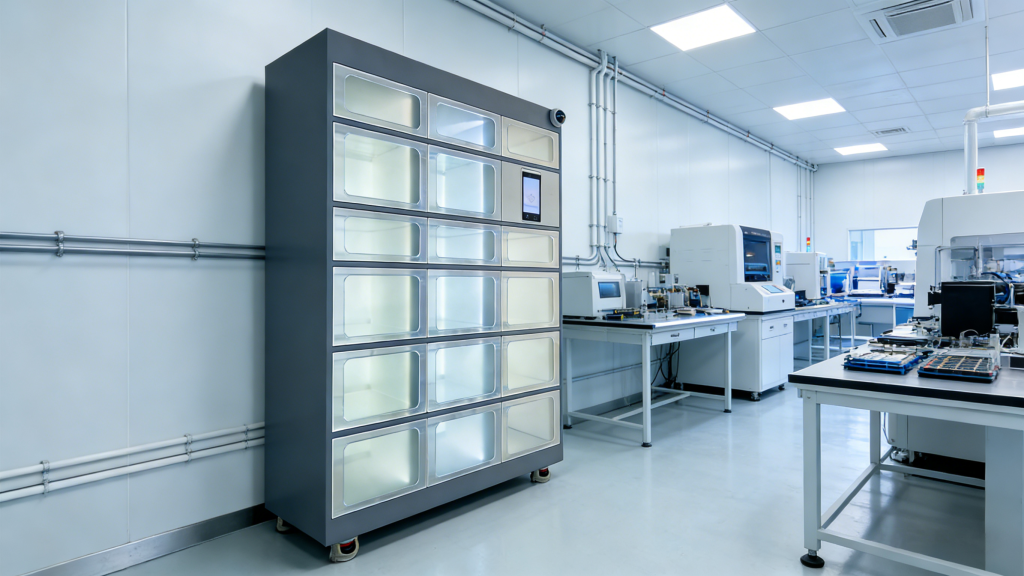
In the global manufacturing industry to ultra-precision, micro-nano-level processing of the background, the traditional workshop materials management model is encountering unprecedented challenges. Aero-engine blade tolerance needs to be controlled within ± 0.005mm, optical lens surface roughness of nanometer level, these extreme process requirements have forced the production of auxiliary materials management must reach an unprecedented degree of refinement. However, most of the precision processing enterprises still use the rough manual weighing + paper record mode, resulting in material loss rate as high as 12%-18%, due to weighing deviation caused by the batch of scrapping events occurring 1.7 times a month. In this context, the lattice-type intelligent weighing material cabinet with its “microgram-level measurement + full life cycle traceability + adaptive learning” core competence has become a key breakthrough to crack this industry problem. In this paper, we will analyze how the system reconstructs the material management system of precision machining workshop from the three dimensions of technological innovation, scene adaptation and value creation.
II. In-depth analysis of management pain points in the traditional model
2.1 Serious misalignment between weighing accuracy and process requirements
Precision machining using cutting fluid, lubricating oil, grinding paste and other auxiliary materials, the proportion of its addition directly affects the processing accuracy. A turbocharger production enterprise has been due to the operator's experience in estimating the amount of lubricant, resulting in bearing temperature rise exceeds the standard, the finished product roundness error exceeds the permissible range, the whole batch of 200 pieces of impellers were forced to scrap. Laboratory tests show that the ideal amount of grease supply for the process should be injected into each aperture Φ8mm 0.42g, while the actual operation fluctuation range of ± 0.15g, far beyond the process permit ± 0.03g tolerance. This artificial uncertainty has become a major obstacle to yield improvement.
2.2 Collaborative failures caused by information silos
Conventional electronic scales scattered around the machines created data pockets, making it difficult for the quality department to obtain continuous production beat data. When abnormal tool wear suddenly occurs on a production line, it is often only noticed after the fact. Worse still, verbal communication during handovers between different shifts could easily lead to information distortion. One night shift worker mistook ISO VG68 lubricant for VG46, causing the precision spindle to hold up and costing more than 500,000 RMB to repair. This kind of cross-departmental coordination error causes hundreds of hours of effective working hours lost to the enterprise every year.
2.3 Inventory black hole eats into profit margins
The open shelf + free pickup model has spawned covert resource abuse. Infrared thermal imaging showed that in a constant temperature workshop, operators frequently traveled between the rest area and the work area, entrapping a small amount of special grease each time, which accumulated over time to form an abnormal consumption equivalent to 15% of the book inventory. together with the emergency procurement premium caused by the lack of an early warning mechanism, the combined cost accounted for 9.8% of the annual material expenditure.
2.4 Compliance Risks Threaten the Foundations of Survival
The aerospace sector strictly enforces the AS9100D quality management system, which requires that all key materials must have a complete traceability chain of evidence. The hand-filled material requisition form has fuzzy handwriting, and the phenomenon of signature on behalf of the common, once the quality problem occurs, there is no way to locate the responsible link. A listed company was unable to provide records of the use of a certain batch of titanium alloy welding wire, missing an important customer order and incurring a direct economic loss of more than ten million dollars.
Third, the technological breakthrough and innovative structure of the lattice mouth type intelligent weighing material cabinet
To address the above pain points, a new generation of lattice-type intelligent weighing material cabinets through the “hardware + software + algorithm” trinity design, building a solution covering the whole process of “receipt - storage - receive - use - return”, and its core technology system consists of four modules:
3.1 Precise Perception Layers at the Microscopic Scale
- Nanoscale Load Cells: It adopts quartz crystal resonant sensor with resolution up to 0.001mg and temperature drift ≤±0.0001%/℃, which can maintain stable output even under vibration working condition. Combined with self-calibrating weight bin, it is automatically calibrated every hour to ensure long-term reliability.
- Multi-dimensional environmental compensation system: Built-in temperature and humidity, air pressure, gravity acceleration sensors, real-time correction of air buoyancy effects. In the application of an aerospace parts factory, the system successfully eliminates the weighing error caused by altitude difference, so that the parts produced in different places have the same heat treatment effect.
- Spectral Recognition Error Prevention Mechanism: The near infrared spectrometer can identify the type of material in 0.3 seconds, preventing the mis-taking of similar-looking materials. An intern once tried to take ordinary petroleum jelly instead of vacuum grease, and the equipment immediately issued an audible and visual alarm and locked the cabinet door.
3.2 Edge computing-driven control centers
- Dynamic inventory sandboxing: Based on digital twin technology, preload the production plan for the next 72 hours and simulate the material demand curve under different schedules. When an upcoming bottleneck process is detected, alternate channels are activated in advance to avoid stopping the line for material.
- Adaptive Learning Engine: Apply reinforcement learning algorithms to continuously optimize the optimal stock level. Practical data from a medical device factory showed that after three months of training, the safety stock level dropped by 40% and the number of out-of-stocks went to zero.
- Blockchain Depository Gateway: Each transaction generates a unique hash value to be written into the alliance chain, and forensic institutions can directly access the tamper-proof evidence chain. In an audit of a military industrial unit, the system helped to quickly clarify the attribution of responsibility and avoid millions of dollars in potential compensation.
3.3 Revolutionary upgrade of human-computer interaction
- AR-assisted picking system: Operators wearing HoloLens glasses can see virtual guidelines superimposed on physical objects, and novices can find target materials as accurately as experts. Boeing has used them for fastener distribution on airplane assembly lines, reducing the error rate to one in 100,000
- Speech Semantic Understanding InterfaceThe natural language command “Give me 3ml of antiwear hydraulic oil” is parsed into a precise sequence of actions, freeing up your hands and improving your work efficiency at the same time. The customized voice module provided by KDDI has a dialect recognition accuracy of over 98%.
- Haptic feedback gloves: Vibrating motor indicates whether the current operation is correct or not, especially in clean room environments where complex operations can be performed without visualization. After the trial at Samsung Semiconductor Factory, the number of cleanroom violations was reduced by 76%.
3.4 Eco-Connected Intelligent Platform
- OPC UA protocol stack: Seamlessly interfacing with various types of PLC controllers and realizing semantic interoperability between devices. With this, Siemens Chengdu Digital Factory opens up the value chain from order to delivery, increasing the speed of order response by 3 times.
- Predictive Maintenance Cloud Brain: Characteristic parameters such as motor current and bearing temperature are collected to predict the risk of failure in advance. After deployment by a wind power gearbox manufacturer, unplanned downtime was reduced by 651 TP3T and maintenance costs by 401 TP3T.
- Carbon Monitoring Dashboard: Quantify the environmental footprint of each material to support green manufacturing decisions. Ningde Times battery factory used this feature to optimize the supply chain, and energy consumption per unit of output value dropped by 18%.
Typical application scenarios and effectiveness verification
4.1 Lean Practices in an Ultra-Clean Shop for Optical Components
Sunny Optical has deployed customized smart cabinets on its cell phone lens production line with remarkable results:
✅ Precise control of trace materialsThe amount of UV adhesive applied was reduced from ±0.5mg to ±0.05mg, and the lens bonding concentricity compliance rate jumped from 92% to 99.8%.
✅ Intelligent maintenance of cleanliness: HEPA filtration system linked differential pressure sensor, always maintains ISO Class 1 clean environment. Particle counter shows that the concentration of ≥0.3μm particles in the air never exceeds the warning value.
✅ Closed loop error correction: Once the material type is found to be inconsistent, immediately freeze the product flow of the batch and wait for the quality engineer to confirm. Since its launch, there has not been a single mixing accident.
👉 economic benefit: Annual raw material cost savings of about 3.8 million yuan, capacity increase of 25%, payback period of only 1.2 years.
4.2 Pollution Prevention Battle in Semiconductor Fabs
CK Storage introduces explosion-proof smart cabinet in 3DNAND flash memory production line to overcome the problems of high-risk scenarios:
✨ Double-lock management of highly toxic chemicalsHazardous chemicals such as hydrofluoric acid are subject to a “one person, one key” system, which can only be opened after double biometric verification. The leakage monitoring system is capable of triggering an emergency response at ppb-level concentrations.
✨ On-line preparation of ultrapure water: Integrated EDI deionization module produces ultrapure water with resistivity ≥18.2MΩ-cm to meet the needs of advanced process cleaning. Compared with purchasing barrel water, the cost is reduced by 60%.
✨ Particle pollution prevention and controlThe laminar flow hood + negative pressure design ensures that no turbulence will occur even at the moment of opening and closing. Particle counter real-time monitoring, exceeding the standard instant alarm.
👉 strategic valueThe company's products have been widely recognized as the best in the industry, and have helped the domestic memory yield break through the 95% mark and break the monopoly of foreign countries.
4.3 Extreme Challenges in New Energy Battery Production
Application case of Ningde Times square aluminum core production line shows unique advantages:
⚡ Constant current supply for high viscosity slurriesOriginal Screw Pump + Visual Positioning System ensures the thickness uniformity of the pole piece coating with CV value <1%. 15% of raw material is saved compared with the traditional manual coating.
⚡ NMP Solvent Recovery & Regeneration: Condensation recovery unit increases VOC conversion to 98%, which is both environmentally and economically friendly. Approximately $700,000 worth of solvents are recovered each month.
⚡ Big Data Early Warning Escort: Early warning of possible coating head clogging failures through deep learning of historical data, avoiding the loss of 3 hours of downtime caused by each cleaning.
👉 industry benchmarking effectThe project has been selected as the intelligent manufacturing demonstration list of the Ministry of Industry and Information Technology, attracting a number of domestic and foreign automobile enterprises to come to study and learn.
V. Implementation path and critical success factors
5.1 laddering strategy
| point | Core tasks | Key technical support | Expected results |
|---|---|---|---|
| Pilot Attack | Single demonstration line to verify feasibility | High Precision Weighing + Basic IoT | Recover hardware costs within 3 months |
| local replication | Batch promotion of similar workshops | Edge Computing + Lightweight MES Docking | Coverage of 80% within six months |
| global coherence | Cross-plant connectivity | Industrial Internet Platform + Big Data Cockpit | Annual consolidated efficiency gains ≥25% |
| ecological co-construction | Upstream and downstream supply chain collaboration | Blockchain + Supplier Portal | Reduction in inventory turnover days by 40% |
5.2 Supporting measures for organizational change
- New postingsThe role of “Material Data Analyst” was created to uncover improvement opportunities behind the massive amounts of data. An automotive parts group discovered that adjusting the order of application of a certain sealant could shorten the curing time by 20%.
- Performance incentives: Indicators such as inventory turnover and weighing pass rate were included in the KPI assessment, and the bonus pool was linked to the amount of savings. This move proved to be a threefold increase in the number of improvement suggestions initiated by employees.
- Knowledge Management System: Established an internal Wiki encyclopedia with solutions to common problems. The training cycle for newcomers has been shortened from two weeks to three days, and the speed of getting started has increased dramatically.
5.3 Risk prevention and control measures
- Electromagnetic compatibility design: CE/FCC certified to ensure stable operation in a strong electromagnetic interference environment. In the application of an electroplating workshop, it has withstood the test of strong interference generated by high-frequency pulse power supply.
- Disaster recovery plan: The double guarantee of local cache + cloud backup enables quick business recovery even in extreme situations. Feedback from enterprises that have experienced typhoon attacks, data integrity after system restart reaches 100%.
- User Experience Optimization: Regularly collect feedback from frontline operators and continuously iterate the interface design and interaction logic. The latest gesture control function makes it more convenient to work with gloves.
VI. Future direction of evolution
With the development of quantum sensing, brain-computer interface and other cutting-edge technologies, the lattice mouth type intelligent weighing material cabinet will usher in disruptive changes:
🔭 Sub-millimeter wave radar rangingThe MIT Media Lab has demonstrated prototypes that measure large parts without touching them and automate loading and unloading in conjunction with a robotic arm.
🔭 Brainwave Intent Recognition: Capture the operator's level of concentration through the EEG helmet, and remind to take a break or change materials at the right time. Toyota Research Center is exploring commercial applications in this area.
🔭 Photonic computers accelerate computing: Parallel processing using photonic chips to speed up the execution of complex scheduling algorithms by more than a hundred times. The latest research from Google's Quantum AI team promises to be a game changer.
